
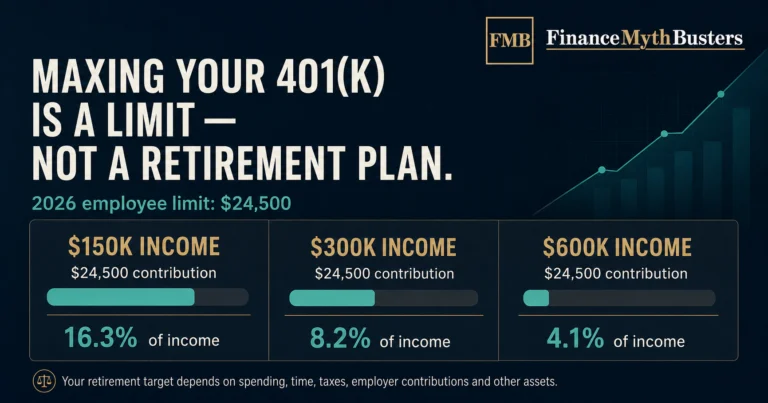
Is Maxing Out Your 401(k) Enough for Retirement?
The 2026 employee contribution limit is $24,500. That is a tax-code ceiling, not a personalized retirement target. See the savings-rate math and two worked examples that reach opposite answers.

Turn high income into long-term wealth through investing, retirement planning, asset allocation, risk management, and disciplined decision-making.
The 2026 employee contribution limit is $24,500. That is a tax-code ceiling, not a personalized retirement target. See the savings-rate math and two worked examples that reach opposite answers.
Get a clear snapshot of your financial health across cash flow, emergency reserves, debt, insurance, retirement, taxes, and other key priorities—all in one guided checkup.
It Depends
Read the AnalysisFor some households, comfortably. For others, not close. The answer depends on expected retirement spending, existing assets, retirement age, guaranteed income, taxes and how much of the portfolio is pre-tax. Two households can both max their plans and still reach opposite conclusions.
The 2026 employee elective-deferral limit is $24,500. Eligible participants age 50 or older can generally make an $8,000 catch-up contribution, while eligible participants ages 60 through 63 may have an $11,250 catch-up tier if the plan offers it. The broader annual-additions limit is $72,000 before catch-ups.
Generally, no. Employer matching and profit-sharing contributions do not reduce the regular employee elective-deferral limit, but they generally count toward the broader $72,000 annual-additions limit.
Start by confirming the full employer contribution and reviewing cash reserves, high-interest debt and near-term liquidity. Depending on eligibility and plan features, other options can include an HSA, IRA or Roth strategy, voluntary after-tax 401(k) contributions and a taxable brokerage account. There is no universal account order.
Often, but not automatically. A fixed-dollar contribution becomes a smaller percentage of income as earnings rise, and the 2026 §401(a)(17) compensation limit can stop employer contributions from scaling above $360,000 of compensation counted by the plan. The right answer still depends on spending, assets, retirement timing and other income.
You are in the large majority. Vanguard reports that about 14% of participants reached the statutory maximum in 2025. Capturing the full employer contribution, raising your savings rate over time and measuring progress against a realistic retirement target can matter more than reaching the annual ceiling.