Short answer
If your federal withholding is running behind, first separate the underpayment-penalty target from your projected final tax bill. For a W-2 employee, increasing withholding can also have different timing consequences from making a late estimated tax payment.
If you discover a withholding shortfall late in the year, the problem may still be fixable. But the amount you expect to owe when you file is not necessarily the first number to solve.
Start with two questions:
- Will the amount and timing of your payments create a federal underpayment penalty?
- How much federal tax will you ultimately owe for the year?
Those are different questions. And for a W-2 employee, there is another distinction that matters: federal income tax withholding and estimated tax payments are not treated the same way under the default Form 2210 timing rules.
Safe harbor is a penalty rule, not a payment plan
The federal income-tax system is pay-as-you-go. Tax is expected to reach the government throughout the year through withholding, estimated payments, or a combination of the two.
For most individual taxpayers, the general safe-harbor framework compares a current-year benchmark with a prior-year benchmark. IRS Publication 505 describes the required annual payment as the smaller applicable amount.
A safe-harbor calculation can reduce or eliminate federal underpayment-penalty exposure. It does not determine your final tax bill.
Keep these two numbers separate
Penalty target: how much generally needs to be prepaid to satisfy the applicable underpayment benchmark.
Full-year projection: how much federal tax you expect to owe for the entire year.
The two tests that determine the general target
| Test | General amount | What it requires |
|---|---|---|
| Current-year test | 90% of expected 2026 tax | A reasonably accurate projection of this year’s federal tax. |
| Prior-year test | 100% of 2025 total tax | A prior-year return covering a full 12 months. |
For certain higher-income taxpayers, the prior-year percentage changes from 100% to 110%. For 2026, the higher-income rule generally applies when 2025 adjusted gross income was more than $150,000, or $75,000 if the taxpayer’s 2026 filing status is married filing separately.
Run both applicable benchmarks and use the smaller amount. A lower current-year tax projection can make the 90% test more favorable; a volatile current year can make the known prior-year amount easier to plan around.
Sources: IRS Publication 505 (2026) and IRC Section 6654.
The $1,000 screen
Estimated tax generally becomes relevant when you expect to owe at least $1,000 after subtracting withholding and applicable credits and your withholding and credits are below the applicable percentage benchmark. That is different from simply asking whether the eventual filing balance will be greater than $1,000.
Source: IRS Publication 505 (2026).
Withholding and estimated payments are credited differently
This timing rule is what can make a late-year payroll correction unusually useful.
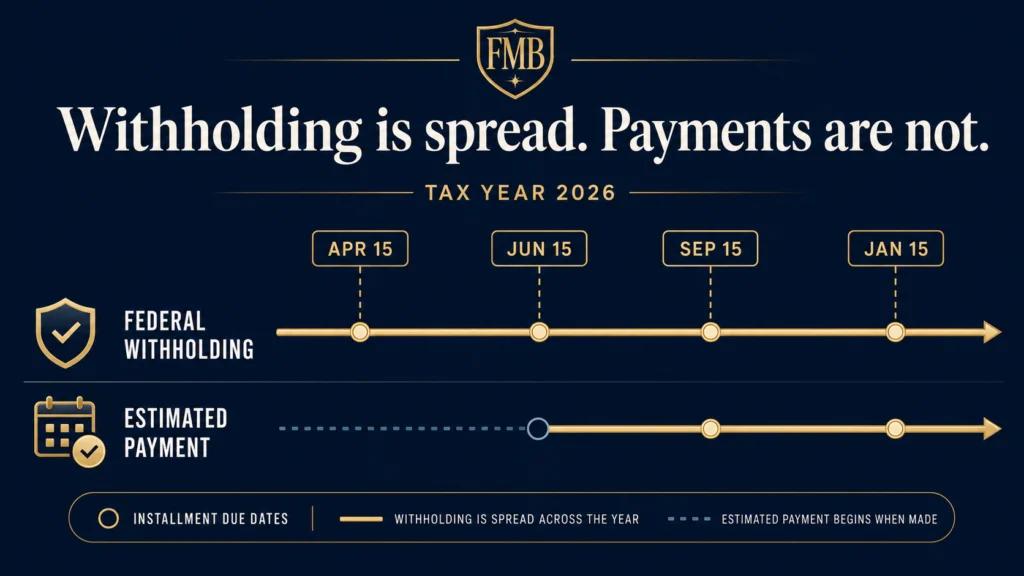
Under the default Form 2210 treatment, withheld federal income tax is generally treated as though one-fourth of the year’s withholding was paid on each installment due date. A taxpayer can instead use actual withholding dates in certain circumstances, but that requires the relevant Form 2210 election and calculation.
For a calendar-year taxpayer, the regular 2026 installment dates are April 15, June 15, September 15, 2026, and January 15, 2027.
Sources: Instructions for Form 2210 and IRS Publication 505 (2026).
Important precision point
Late-year withholding is not literally backdated to an earlier paycheck. Under the default penalty calculation, annual withholding is generally allocated ratably across the installment dates. Estimated payments, by contrast, are credited based on when they are actually made.
That means two households can discover the same shortfall on the same day, move the same number of dollars, and still have different penalty timing results depending on whether the correction moves through payroll or an estimated payment.
Your catch-up window is personal
There is no single IRS calendar date that tells every employee when a withholding correction becomes too late. Your practical window depends on the size of the shortfall, the payroll opportunities remaining, the wages available to support additional withholding, and the employer’s processing timeline.
Suppose the amount you want payroll to catch up is $20,000.
| Usable payroll opportunities remaining | Additional withholding needed per opportunity |
|---|---|
| 8 | $2,500 |
| 6 | $3,333 |
| 4 | $5,000 |
| 2 | $10,000 |
The numbers are illustrative. The pattern is what matters: as usable payroll opportunities disappear, each remaining paycheck must carry more of the correction. Eventually the requested withholding may exceed the wages or payroll flexibility still available.
Payroll processing matters too
IRS Publication 15 says a replacement current-year Form W-4 must be put into effect no later than the start of the first payroll period ending on or after the 30th day after the employer receives it. An employer may implement the change sooner.
Source: IRS Publication 15 (2026).
That is why every paycheck still visible on a calendar should not automatically be counted as usable withholding capacity. If you want a fixed additional amount withheld from regular wages, Form W-4 Step 4(c) is the relevant field.
Source: Form W-4.
A worked example
Consider a hypothetical married couple filing jointly for 2026. They have $410,000 of combined base salary, $220,000 of RSU income during the year, $49,000 of combined pretax workplace-plan deferrals, the 2026 standard deduction, a 2025 return showing $104,000 of total tax, and 2025 AGI above the $150,000 safe-harbor threshold.
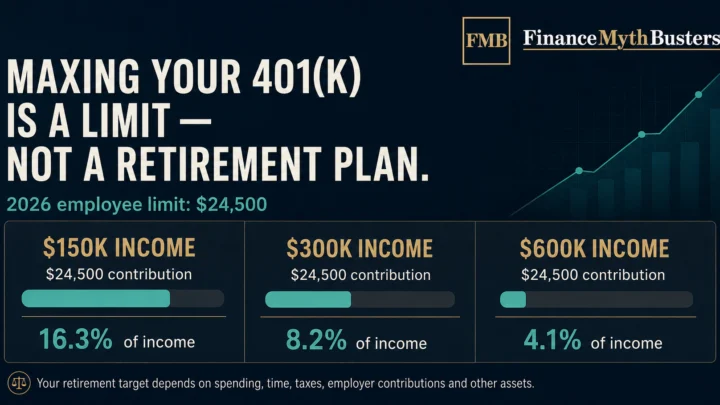
The 2026 employee elective-deferral limit is $24,500, so $49,000 represents two assumed employees each making a full $24,500 deferral. The 2026 standard deduction for married couples filing jointly is $32,200.
Sources: IRS 2026 retirement limits and IRS 2026 inflation adjustments.
For illustration, assume projected 2026 total federal tax of approximately $133,000 and projected federal income-tax withholding of $72,000. The $72,000 is a deliberately assumed paystub-based full-year projection. It is not reconstructed from a default Form W-4 or from an assumption that every RSU dollar was withheld at 22%.
Tool reconciliation note
The FMB Withholding Safe Harbor Check is a directional planning tool and does not model every tax item. Its estimated liability can differ from this simplified household example. Use the calculator for the safe-harbor planning target, then reconcile the full-year tax projection separately.
| Item | Amount | Calculation / meaning |
|---|---|---|
| Projected 2026 total tax | $133,000 | Illustrative projection |
| 90% of current-year tax | $119,700 | 90% x $133,000 |
| 110% of prior-year tax | $114,400 | 110% x $104,000 |
| Required annual-payment benchmark | $114,400 | Smaller of the two |
| Projected federal withholding | $72,000 | Assumed full-year paystub projection |
| Gap to benchmark | $42,400 | $114,400 – $72,000 |
| Still potentially due at filing after reaching benchmark | $18,600 | $133,000 – $114,400 |
The last line is the point. Closing the $42,400 safe-harbor gap does not necessarily eliminate the filing balance. If the household wanted to prepay the entire projected tax bill instead, it would need to address approximately $61,000 rather than $42,400.
Same shortfall, three possible timing outcomes
Now suppose the couple identifies the problem in early September and has enough remaining payroll capacity to absorb $42,400 of additional withholding. To isolate the timing mechanics, assume a flat 7% annual underpayment rate for the illustration.
Actual Form 2210 calculations use the applicable rates and the taxpayer’s actual payment facts. IRS rates can change quarterly. For 2026, the IRS has posted individual underpayment rates of 7% for the first quarter, 6% for the second, 7% for the third, and 7% for the fourth quarter.
Source: IRS Quarterly Interest Rates.
| Route | Illustrative penalty | Why |
|---|---|---|
| Do nothing | About $1,970 | The modeled shortfall remains unpaid through the relevant periods. |
| Make a $42,400 estimated payment on September 15 | About $500 | The payment stops further modeled exposure as applied, but earlier periods were already underpaid for part of the year. |
| Add $42,400 of withholding through payroll before year-end | About $0 | Under the default ratable withholding treatment, annual withholding reaches the modeled required installment amount. |
These are illustrations, not prepared Form 2210 results. The lesson is not that payroll is always better. The lesson is that payment method and timing interact. The underlying tax is still owed either way, and accelerating withholding has its own cash-flow tradeoff.
When an estimated payment can still be the better route
Additional payroll withholding is useful only if payroll can actually carry the amount. An estimated payment may be more practical when:
- Too few usable paychecks remain.
- The remaining wages cannot support the extra withholding.
- The employer cannot process the change in time.
- The income causing the shortfall is not wage income.
- You want to stop further modeled underpayment exposure immediately rather than wait through payroll cycles.
- You already made estimated payments whose dates need to be incorporated into a fuller Form 2210 calculation.
The two methods are not mutually exclusive. A household with a large shortfall may increase withholding as much as practical and use an estimated payment for the remainder.
What if the income really arrived late in the year?
A different method can matter when income itself was uneven. IRS Publication 505 describes the annualized income installment method, which can adjust required installments when income was not earned evenly throughout the year.
Source: IRS Publication 505 (2026).
This can be relevant after a large late-year capital gain, business-income event, or other genuinely uneven income pattern. It requires more recordkeeping and generally requires Form 2210 with the return. That is a different analysis from simply increasing payroll withholding.
What to gather before changing anything
Before submitting a new W-4 or sending an estimated payment, gather:
- Prior-year federal return: total tax and AGI.
- Current-year filing status.
- Federal income-tax withholding year to date for every wage earner.
- Expected remaining wages and usable pay dates.
- Upcoming bonuses, commissions, and equity vests, including timing.
- Estimated tax payments already made, including their dates.
- Expected investment income, realized gains, business income, and other material tax events before year-end.
Use two separate calculations
Penalty target: How much generally needs to be prepaid to address the underpayment-penalty benchmark?
Full-year projection: How much federal tax do you expect to owe for the entire year?
State taxes are a separate calculation
Everything in this article is federal. States with individual income taxes can use different safe-harbor percentages, payment schedules, thresholds, and withholding rules.
A federal payroll correction does not automatically solve a state underpayment problem. Treat state tax as its own calculation.
What to do next
- Pull last year’s total tax and AGI.
- Project this year’s federal tax.
- Calculate both applicable safe-harbor benchmarks and use the smaller one.
- Project full-year federal withholding and include estimated payments already made.
- Measure the remaining shortfall to the penalty benchmark.
- Check whether remaining payroll can realistically carry the correction.
- Calculate the projected filing balance separately.
If the shortfall fits comfortably inside the payroll opportunities still available, a W-4 change may be a practical route. If it does not, an estimated payment, a combination of approaches, or a more detailed Form 2210 analysis may be appropriate.
Safe harbor can solve a penalty problem. It does not make an unpaid tax bill disappear.